
How to build a board report your board actually reads
Five numbers, one page, and the same format every month. A practical structure for chamber board reporting that survives contact with a volunteer board.
Most chamber board reports are assembled the weekend before the meeting, run to fifteen pages, and are read in the parking lot ten minutes beforehand. The problem isn’t board engagement. It’s that the report is built to demonstrate effort rather than to support a decision.
Here is a structure that fixes both ends of that: less work to produce, more likely to be read.
The one-page rule
Your board is volunteers with day jobs. Whatever you put on page one is what gets read; everything after it is an appendix that exists to answer follow-up questions. Design accordingly.
Page one is five numbers, each with its prior-period comparison and a one-line explanation. Everything else — event-by-event breakdowns, the full receivables aging, program updates — goes behind it and is referenced, not summarized.
The five numbers
Active members, and net change. Not just the total. A chamber that gained 14 and lost 12 looks identical to a chamber that gained 2 and lost 0 if you only report the net. Show gross joins, gross losses, and the net, because the two situations demand completely different responses.
Renewal rate, trailing twelve months. A point-in-time renewal rate bounces around with the seasonality of your billing cycle and tells you very little. A trailing twelve-month rate is comparable month to month, which is what makes it a real metric rather than a number.
Dues collected against dues billed. Two numbers side by side. The gap is your receivables problem, and if it’s growing, that’s the single most important line on the page. Boards understand this instantly because it’s the same shape as their own businesses.
Event revenue and attendance, year to date, against the same period last year. Events are where most boards want to see growth and where most chambers have the least reliable data, because ticketing lives in a different system from everything else.
Cash position or operating reserve. Whatever your treasurer already uses. Don’t invent a new financial metric; use the one your board is already fluent in.
That’s it. Five numbers. If a sixth is genuinely load-bearing for your chamber — a major program, a capital campaign — add it and drop one of the above.
Say what changed and why, in one line each
Under each number, one sentence. Not a paragraph.
Active members: 312 (+8 joined, −5 lapsed, net +3 · prior month 309) Three of the five lapses were in the under-10-employee tier; two cited cost.
That single line does more than a page of narrative, because it tells the board what happened, and gives them the one fact they need to decide whether to ask a follow-up question.
Use the same format every single month
The value of a board report compounds only if it’s comparable. A board that sees the same five numbers in the same order for a year develops an intuition for what normal looks like, and starts noticing anomalies on their own. A board that gets a differently-shaped report every month is re-learning the format instead of reading the content.
This also means resisting the urge to add a metric because it happens to look good this quarter. If you add it, you own it forever — including the months it looks bad.
Distinguish the report from the ask
Board meetings run out of time, and the report is what gets compressed. Keep the reporting and the decision-making separate: page one reports, and a clearly labeled section says what you need from the board this month. If you need a vote, a connection, or a decision, it should not be buried in a paragraph about event attendance.
If the answer to “what do you need from us?” is “nothing this month,” say that explicitly. Boards trust a director who tells them when there’s nothing to decide.
Make it a byproduct, not a project
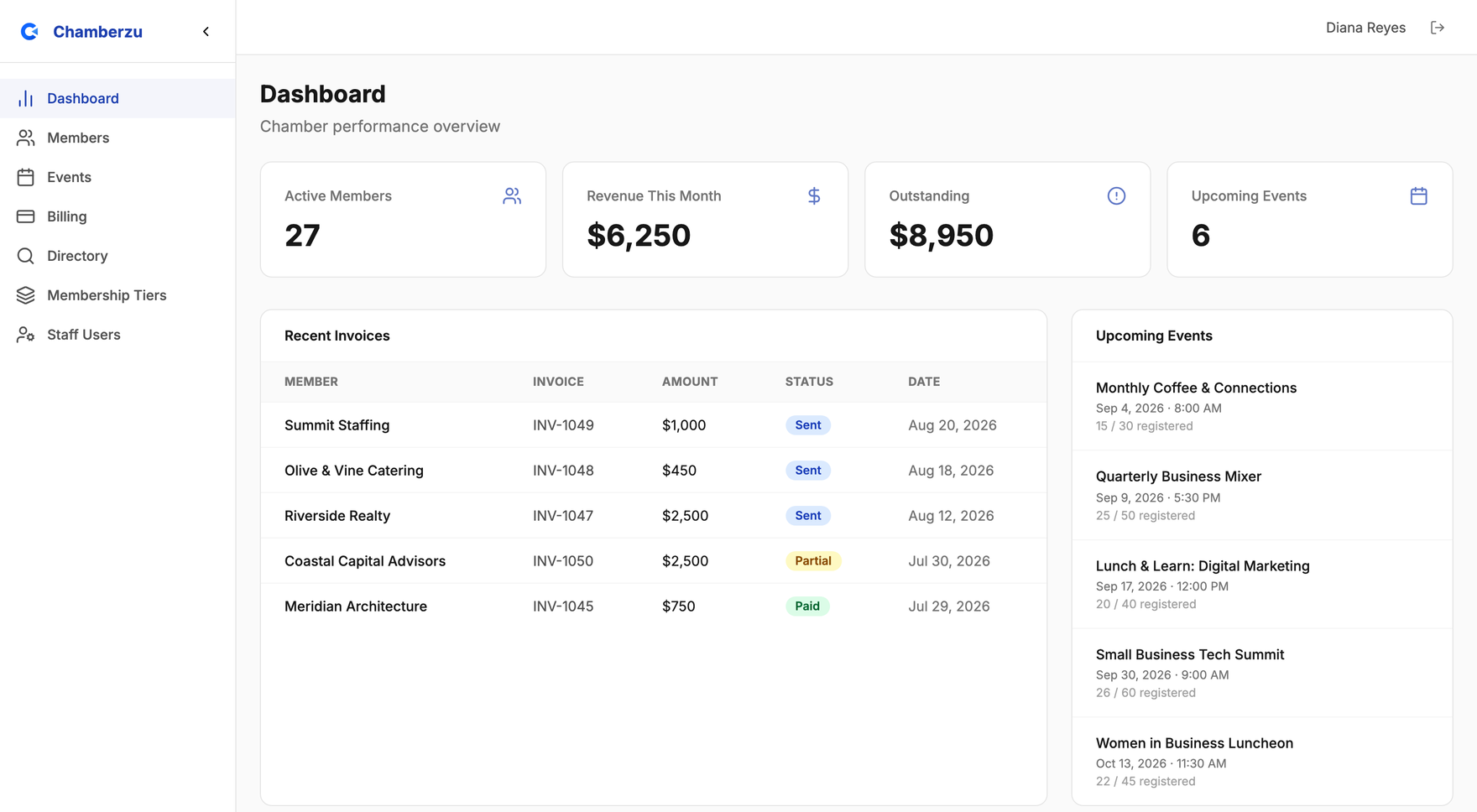
The structural problem with board reporting is that the numbers live in four systems — membership in one, invoices in another, event registrations in a third, and the bank balance in a fourth — so assembling the report is a genuine research task every month. That’s why it happens on a weekend, and why it’s the first thing to slip when the month is busy.
The version of this that works is one where the five numbers are a view you can open at any time, not a document you assemble. When the report is a byproduct of your operations rather than a project, three useful things follow: it comes out on time, it uses consistent definitions, and you can answer a board member’s question during the meeting rather than promising to follow up.
A note on definitions
Whatever you choose, write the definitions down once and don’t change them quietly. “Active member” can reasonably mean paid-in-full, or paid-or-within-grace, or anything not formally lapsed. All three are defensible. What isn’t defensible is the number changing meaning between March and June because a different person built the report.
Put the definitions in an appendix. It takes ten minutes and it’s the difference between a metric and a number.