
Making your member directory actually worth the dues
A member directory is one of the few chamber benefits that can be measured. Here's how to turn a static list into something members can see working — and how to price tiered placement honestly.
“What do I actually get for my dues?” is the hardest question in a membership director’s job, because most honest answers are about intangibles — advocacy, community, connections. A directory listing is one of the few benefits that produces evidence.
Most chamber directories don’t, though, because of how they’re built.
The three failure modes
The PDF. A directory published as a downloadable document is out of date the day after it’s produced, invisible to search engines, and unlinkable. It exists to prove the chamber has a directory rather than to be used.
The unmaintained page. A directory built as static web pages, updated whenever someone gets around to it. Members who lapsed two years ago are still listed. Members who joined last month aren’t. Every phone number is whatever it was when the page was built.
The walled garden. A directory behind a member login. This is the most common and the most self-defeating: it makes the listing invisible to exactly the people a member wants to be found by. Members don’t want to be discoverable by other members who already know them — they want to be discoverable by customers.
The common thread is that in all three cases, a member cannot see the listing working. And a benefit nobody can see working doesn’t affect renewal decisions.
What a directory needs to be worth something
It has to be public and indexable. Each member gets a real page at a stable URL that search engines can crawl. This is the whole game. A chamber directory with a few hundred member pages, each with a business name, description, category, and location, becomes a genuine local search asset — and every member benefits from the aggregate authority of the others.
It has to publish structured data. LocalBusiness schema on each profile makes listings eligible for rich results. This costs nothing once it’s built and meaningfully affects how listings appear in search.
It has to be generated from live data. The directory should be a view of your member database, not a copy of it. A member who lapses drops off automatically; a member who updates their address updates the listing. If publishing a directory change requires a person, the directory will be wrong.
Members have to be able to edit their own listing. Your staff should not be the bottleneck for a member updating their own hours. Give members a self-service way to edit their profile, with optional staff approval if you want editorial control.
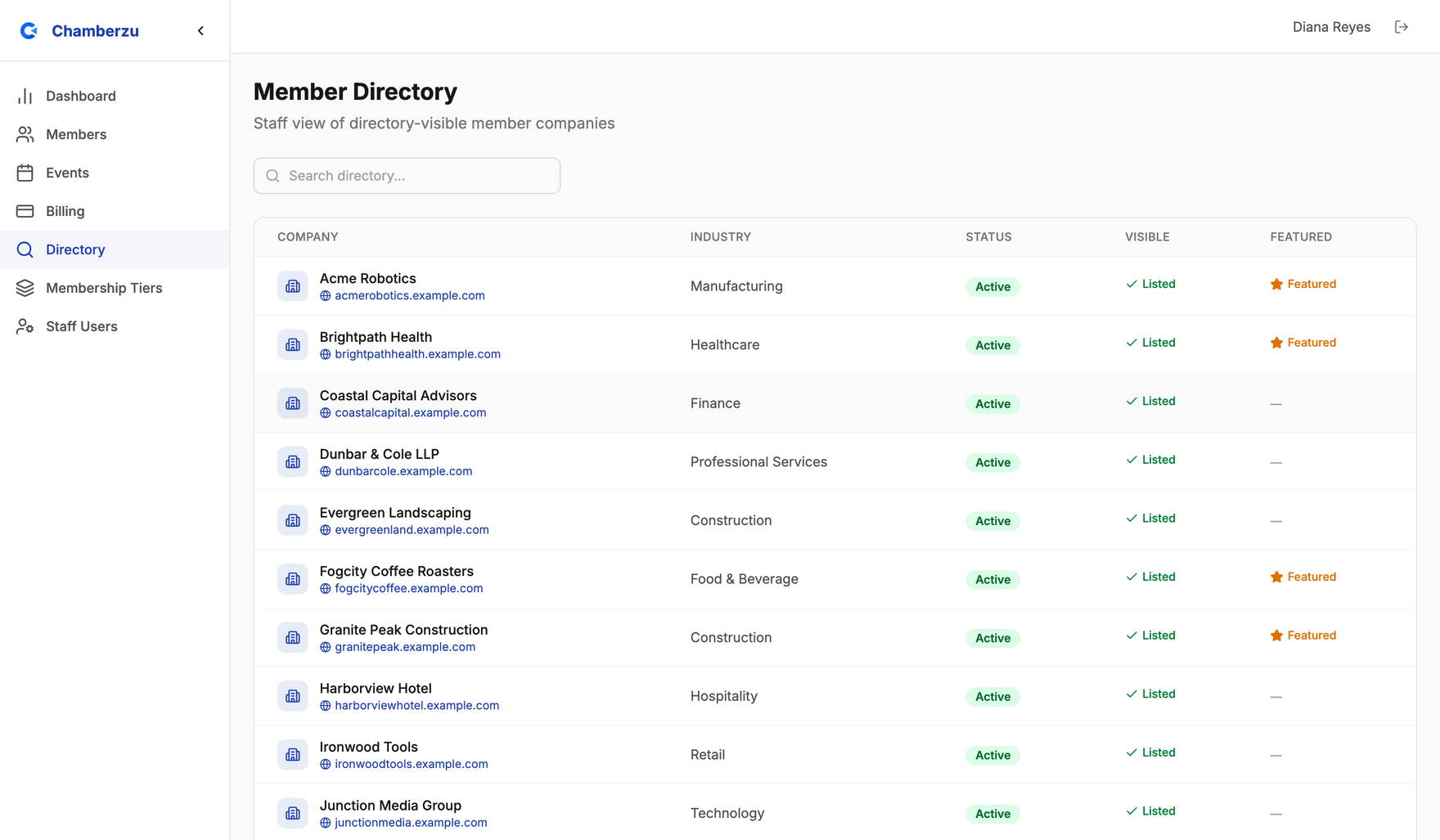
It has to be fast to search. Filter by industry, filter by location, search by name, results appearing as fast as someone types. Most chamber directories fail this trivially, and it’s the difference between a tool people use and a page people bounce from.
Making the value visible
Building it well isn’t enough — members need to see it working. Three things that convert a good directory into a retention argument:
Report referral traffic to members. If you can tell a member “your listing was viewed 240 times last year and sent 31 clicks to your website,” you’ve converted an intangible into a number they can weigh against their dues. This is the single most effective thing a chamber can do with a directory.
Show them their listing during the renewal conversation. Not a screenshot in a deck. Open it on your phone in front of them. Members who haven’t looked at their own listing in three years are often surprised it’s good — and often immediately want to update it, which is engagement you didn’t have to manufacture.
Send an annual “check your listing” email. One email a year asking members to confirm their information. It improves your data quality, reminds them the benefit exists, and gives you a re-engagement touch that isn’t an invoice.
Tiered placement, done honestly
Directory placement is a legitimate reason to upgrade tiers, and it’s one of the few upgrade paths that costs your staff nothing to deliver. But there’s a line between a benefit and a bait-and-switch.
Reasonable: higher tiers sort first within a category, get a featured badge, get a larger listing with a logo and description, get placement on the directory landing page, get a category-level “featured” slot.
Not reasonable: making lower-tier listings so minimal they’re useless, or excluding basic members from the directory entirely. If a member’s listing doesn’t work at all, you’ve made the directory a paid advertising product rather than a membership benefit — and the aggregate SEO value that makes the whole thing work depends on having every member in it.
The test: would a basic-tier member, looking at their own listing, feel like they got something? If not, the tiering has gone too far, and you’re eroding the asset that makes premium placement valuable in the first place.
Keep your existing website
A common objection to improving the directory is that the chamber already has a website it’s happy with, and nobody wants to migrate their web presence to fix one page.
You shouldn’t have to. A directory that’s generated from live member data can be published as its own section, embedded into an existing site, or served from a subdomain. The requirement is that it’s generated rather than hand-maintained — not that it lives in any particular content management system.
The measurable-benefit argument
Chambers spend a lot of energy trying to demonstrate value, most of it on things that resist measurement. The directory is unusual: it produces page views, click-throughs, and search impressions, all of which are attributable to a specific member and reportable back to them.
That makes it worth investing in disproportionately — not because a directory is the most important thing a chamber does, but because it’s one of the few things a chamber does that a member can see working.