
Getting paid faster: dues collection for a two-person chamber office
Practical changes that shorten days-to-payment for chamber dues — payment methods, invoice timing, anniversary vs. calendar billing, and how to handle the members who always pay late.
A chamber with $300,000 in annual dues and an average 45-day collection lag is carrying roughly $37,000 of its own revenue as an interest-free loan to its members at any given moment. Shortening that lag doesn’t require anyone to pay more. It requires removing the reasons they pay late.
Offer the payment method people actually use
Start here, because it’s the largest single lever and the easiest to measure.
If your dues arrive predominantly by check, your collection lag is largely a postal and attention problem rather than a financial one. Adding card and ACH payment shortens the tail substantially — not because members were unwilling, but because a link takes forty seconds and a check takes a trip to a drawer.
Two details matter:
Don’t require an account. The payment link in the invoice email should open a page where the member can pay immediately. A login wall in front of a payment is the most expensive UX decision a chamber can make.
Offer ACH for larger invoices. Card processing fees on a $2,500 platinum membership are real money. ACH costs a fraction of that and most large members prefer it anyway. Let the member choose; most chambers find the split sorts itself out sensibly by invoice size.
Checks don’t disappear, and shouldn’t — some members will always pay that way, and a few will have accounting processes that require it. The goal isn’t to eliminate checks. It’s to stop making checks the default for members who’d happily click a link.
Fix the timing before you fix the copy
Three timing decisions determine most of your collection performance:
Bill early enough to be planned for. An invoice that arrives on the renewal date is a surprise. One that arrives 30 days ahead, with a 60-day heads-up before it, is a budgeted expense. Same money, different psychology.
Pick anniversary billing or calendar billing deliberately. Anniversary billing — each member renews on the date they joined — spreads your revenue and your workload evenly across the year, which is much kinder to a two-person office. Calendar billing — everyone renews January 1 — concentrates the work into a brutal six weeks but aligns with how many small businesses budget, and makes your annual reporting cleaner.
Neither is wrong. What’s wrong is drifting into a hybrid because nobody ever decided, which is the state most chambers are actually in. If you’re currently in the hybrid, moving to anniversary billing is usually the better change for a small staff, and can be done gradually by pro-rating members onto their join dates as they renew.
Don’t send invoices on Fridays. This sounds trivial. It isn’t. An invoice that arrives Friday afternoon is read Monday morning alongside sixty other emails. Tuesday and Wednesday mornings are measurably better for anything you want acted on.
Handle the chronic late payers separately
Every chamber has ten to twenty members who always pay, and always pay late. Treating them with the same automated cadence as everyone else generates noise for your staff and irritation for them.
Pull them out. For that group:
- Ask what would work. Frequently the answer is a purchase order number, an invoice sent to accounts payable rather than to the owner, or quarterly instalments instead of an annual lump. All three are trivial to accommodate and all three fix the problem permanently.
- Offer a payment plan for large invoices. A $5,000 annual membership split into quarterly payments is a member who renews. The same $5,000 as a single line item in January is a member who “will get to it.”
- Get them on autopay if they’ll agree. For a member who has renewed five years running, stored payment with an annual charge and a clear advance notice is a service to both parties.
Make partial and offline payments not break anything
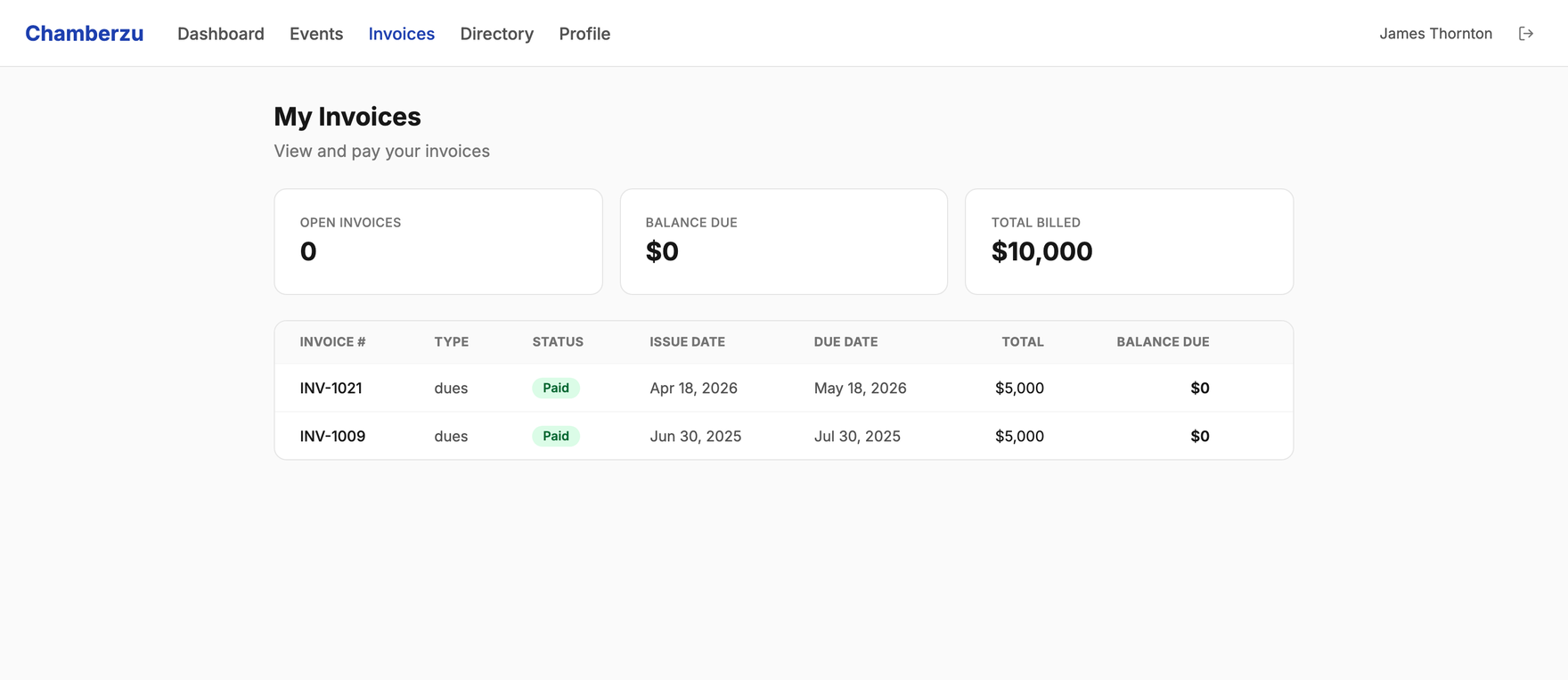
Reality is messier than a payment flow. A member sends a check for a slightly wrong amount. Another pays half now and half next month. A third pays at an event by card, in person, against an invoice that’s already open.
If recording those cases is awkward in your system, staff will work around it — usually in a spreadsheet — and your receivables number stops being true. The test is simple: can someone record a $400 check against a $500 open invoice, in under a minute, and have the balance and the member’s history both stay correct? If not, that’s the thing to fix before you optimize anything else.
Watch three numbers
Days sales outstanding. Average days from invoice date to payment date. Track it monthly. It’s the single number that tells you whether anything you changed worked.
Receivables aging. How much is outstanding at 30, 60, and 90 days. The 90-day bucket is your future lapsed-member list; a member who hasn’t paid in three months has usually already decided, whether or not they’ve said so.
Collection rate by tier. If your smallest tier collects at 95% and your largest at 78%, you don’t have a collection problem — you have a specific problem with large members, and it’s probably about invoicing the wrong contact.
The compounding effect
None of this is clever. Offer a payment link, bill in advance, pick a billing model on purpose, accommodate the members who need something different, and record messy payments cleanly.
But a chamber that shortens its collection lag from 45 days to 20 frees up real working capital, removes a recurring source of staff stress, and — because past-due invoices are the leading indicator of lapsed members — usually improves retention as a side effect it didn’t plan for.