
A renewal sequence that works when nobody has time to chase
The exact cadence, timing, and message content for an automated dues renewal sequence — including the rules that keep it from annoying members who have already paid.
Renewal follow-up is the highest-return process in a chamber office and the first thing to fall over when the office gets busy. The good news is that it doesn’t need judgment — it needs a schedule. What follows is a cadence that works for chambers with two staff and no capacity to chase anyone.
The shape of the sequence
Five touches. Four of them are automated, one of them is a human task, and every one of them stops immediately when payment lands.
| When | What | Who sends it |
|---|---|---|
| 60 days before | Advance notice with the amount and date | Automated |
| 30 days before | Invoice with a payment link | Automated |
| 7 days before | Reminder, shorter, same link | Automated |
| Due date | Due today notice | Automated |
| +14 days | Staff task: call the member | Human |
After the human touch, a light past-due series continues at +30 and +60 days, and the member moves to a lapsed state at whatever boundary your bylaws or board have set — usually 90 days.
Why 60 days
The 60-day notice is the touch chambers most often skip, and it does more work than any of the others. Its purpose isn’t to collect money; it’s to land the number in a member’s head before the invoice arrives, so the invoice isn’t a surprise. For members who budget annually, it’s also the only touch that arrives while they can still plan for it.
Keep it short. The amount, the renewal date, what tier they’re on, and one sentence about something the chamber did for them this year. No payment link — this touch is informational, and adding a link makes it read as an early bill.
Why the 30-day touch is the real invoice
This is the one that has to be right. Three properties matter more than the copy:
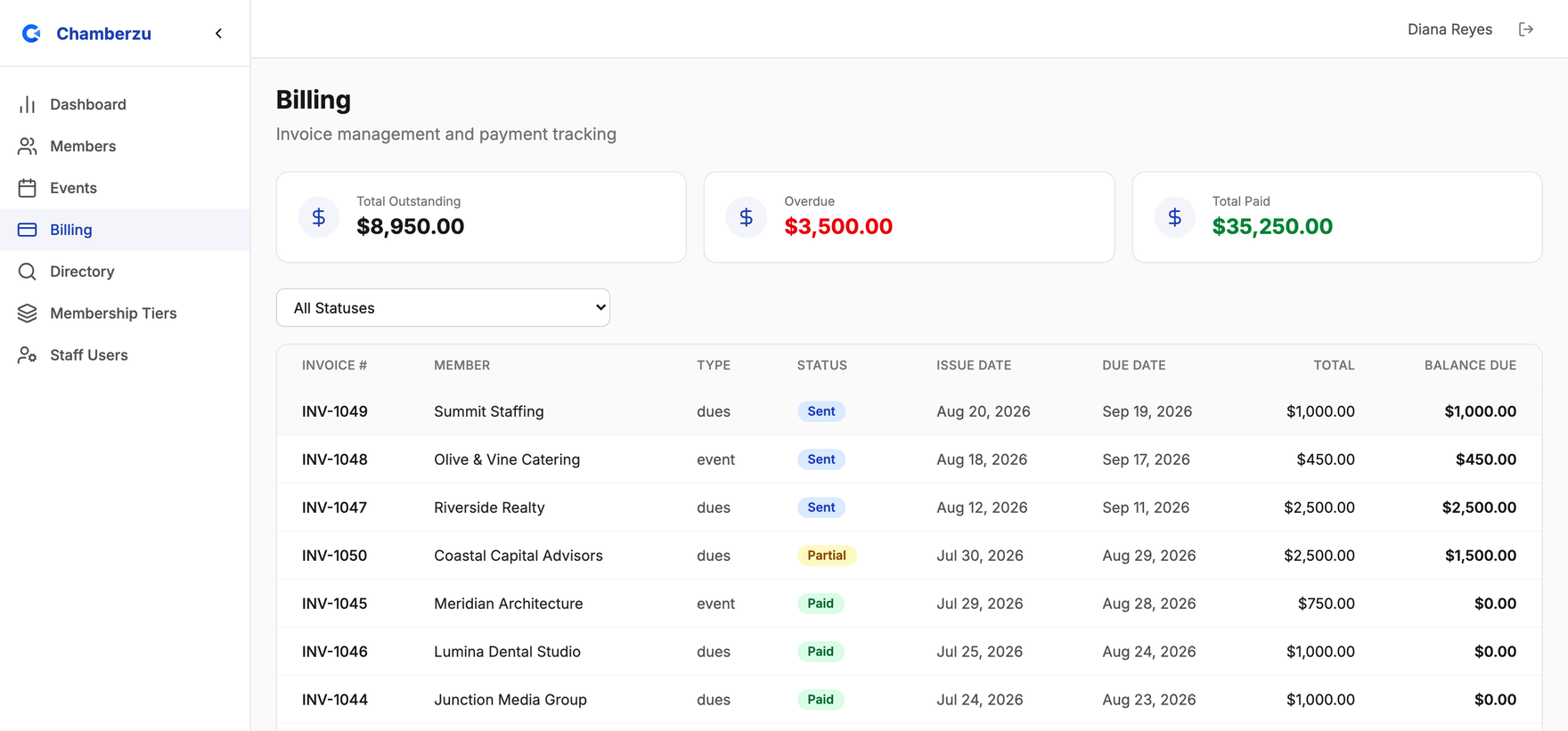
It must be payable in one click. A link that opens a payment page, not an attachment, not a portal login. If the member has to authenticate before they can pay, you will lose a percentage of them at that step for no benefit to you.
It must go to the right person. The billing contact, not the person who joined. Most chambers hold one email per member; the ones with good retention hold several, with roles attached. If your system can’t distinguish “the person who signs the checks” from “the person who attends the mixers,” that’s worth fixing before you tune the email copy.
It must come from your domain. Renewal notices sent from a shared platform sending address land in spam at a rate that will quietly cost you members. Authenticate your sending domain with SPF, DKIM, and DMARC. It’s a ten-minute DNS change and it’s the single highest-leverage deliverability action available to you.
The rules that keep it from backfiring
An automated sequence that misfires is worse than no sequence, because it teaches members that your email is noise. Four rules:
Stop on payment, instantly. Not overnight, not on the next batch run. A member who pays on the 29th and gets a “due in 7 days” reminder on the 30th learns that your reminders don’t mean anything.
Suppress on reply. If a member replies to any touch, pause the sequence and hand it to a person. Someone writing “we’re not renewing this year, here’s why” should never receive another automated reminder.
One channel, one voice. Don’t run a parallel sequence from a separate marketing tool. Members receiving two different renewal reminders from the same chamber conclude that your office is disorganized, and they’re right.
Cap the past-due series. Two past-due notices, then a human, then stop. Continuing to bill a member who has clearly decided to leave converts a lapse into a complaint.
What the human touch is for
The +14 day call exists because at that point, silence has stopped being about logistics. Either something is wrong — an invoice went to the wrong person, the amount is disputed, the business is struggling — or the member is deciding whether to stay. Both are conversations, and neither is solvable by a sixth email.
Keep the call short and make it about them, not the invoice. “I noticed your renewal is outstanding — is everything alright at the business, and is there anything you needed from us this year that you didn’t get?” You will learn more about your chamber in ten of these calls than in a member survey.
Measuring it
Three numbers tell you whether the sequence is working:
- Renewal rate by tier. Segment it. A blended number hides that your smallest tier is churning while your largest is stable, or vice versa.
- Days-to-payment. The gap between invoice date and payment date. If it shortens after you introduce online payment, you had a friction problem; if it doesn’t, you have an attention problem.
- Touches-to-payment. How many reminders the average paying member needs. If most members pay on touch two, your 60-day notice is doing its job. If most pay after the human call, your emails aren’t being read and the problem is deliverability or contact accuracy.
Start with the schedule, not the copy
Chambers spend a lot of energy wordsmithing renewal emails and very little on whether they go out on time, to the right person, from an authenticated domain, with a payment link that works. The second list is worth more than the first.
Get the mechanics right, then improve the writing. Not the other way around.