Encrypted in transit and at rest
- All traffic is served over TLS 1.2 or later with HSTS. There is no unencrypted way in.
- Data at rest is encrypted with AES-256.
- Backups are encrypted to the same standard and stored apart from the main database.

A chamber holds business contact details, payment records, and years of relationship history. This page says plainly how that data is protected.
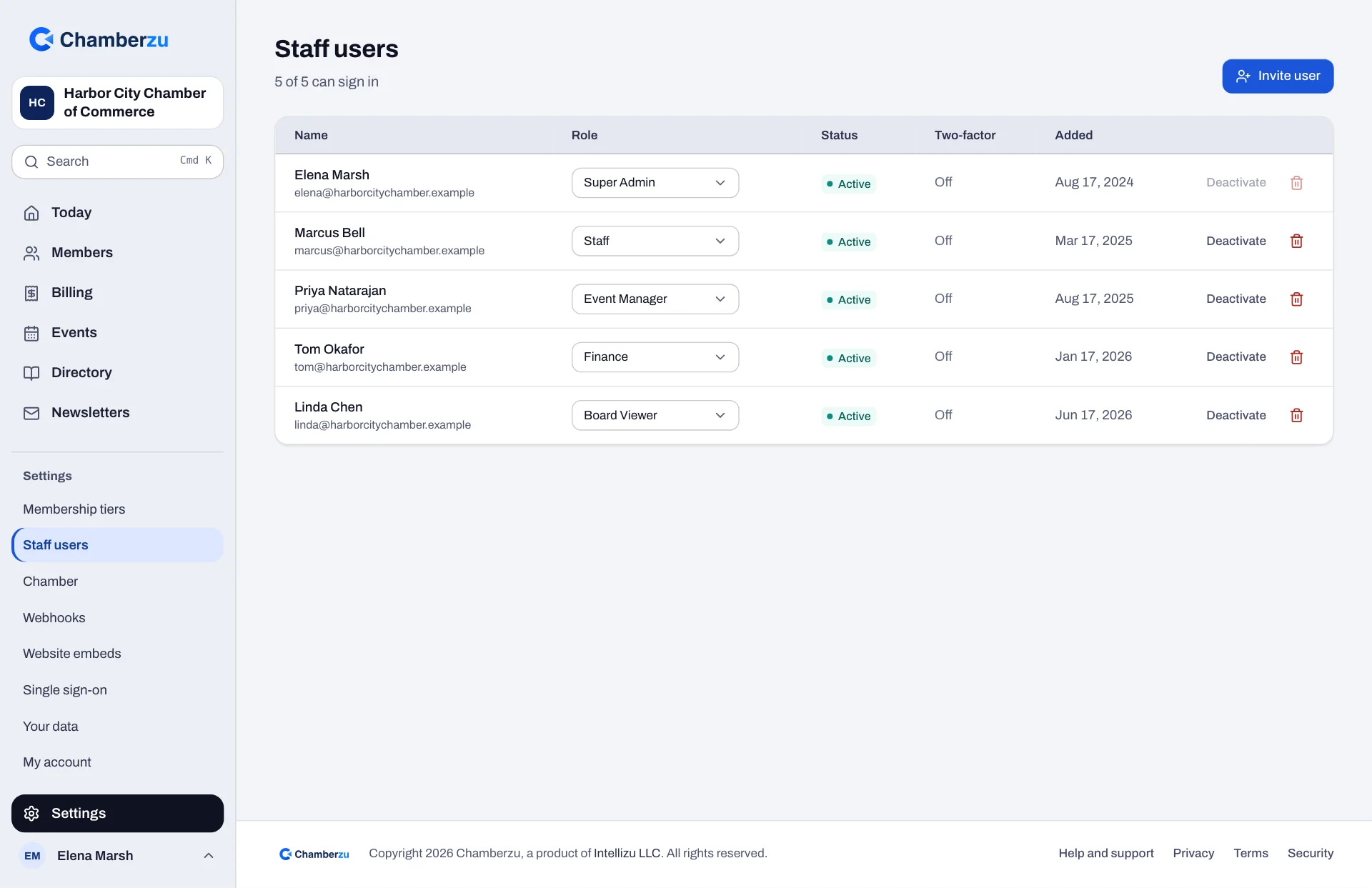
Permissions are not a bullet on a feature list. Every staff account carries a role, and the server checks it on every request, so a committee volunteer can run their programme without ever seeing member financials.
Controls are table stakes. These are the policy choices behind them.
You own every record you put into Chamberzu and can export all of it at any time, in open formats, without asking us. We do not sell member data, and we do not use your members' information to market to them.
Cancel and we delete your data within 90 days, backups included, or sooner if you ask. Until then, ask and we send you a full export.
Access to production data is limited to the engineers who need it, requires multi-factor authentication and is logged. Support works with the fewest privileges that resolve your request.
Principally AWS for hosting and email delivery, and Stripe for payments. Each is contractually bound to protect data processed for us, and we send the current list on request.
If a breach affects your chamber's data, we tell you directly what happened, what was affected and what we are doing about it. Not a footnote on a status page.
Report a vulnerability and we acknowledge it within two business days. We do not pursue legal action against researchers who report in good faith and give us reasonable time to fix it.
Need a full security questionnaire completed, or our current security roadmap? Send us a message and we'll turn it around.
In the United States, on AWS. If your chamber has a specific residency requirement, talk to us before you sign anything.
Not yet. We are building to SOC 2 controls and intend to complete a Type II audit, but we will not claim a certification we do not hold. We are happy to complete a security questionnaire in the meantime.
We will sign a data processing agreement. We do not handle protected health information, so a BAA does not apply to how chambers use Chamberzu.
Only engineers with a specific operational need, through logged access that requires multi-factor authentication. Support cannot browse your members, and nobody reads your data for analytics.
Yes. Roles cover membership, events, finance and read-only access, so a committee volunteer can run their program without seeing member financials.
Send security reports to our team through the contact form and we'll acknowledge within two business days. We don't pursue researchers who report in good faith.
Reports go to a human, not a ticket queue. Please give us reasonable time to fix an issue before disclosing it.