Solutions

Built for the way your chamber actually runs.

A 90-member chamber and a 2,000-member regional chamber have almost nothing in common operationally — except that both are usually running on software designed for neither. Find the shape that matches yours.

By chamber size

Where you are now.

The problems change as you grow. So does what "good software" means.

Under 250 members

Small chambers

One or two staff, and everything lands on them.

At this size there is no "membership department" — there's you, maybe a part-time assistant, and a board that meets monthly. The bottleneck isn't strategy, it's hours. Every hour spent reconciling a payment is an hour not spent recruiting a member.

What changes

  • Dues invoicing and renewal reminders run without anyone remembering to send them
  • Members pay online instead of mailing checks to a PO box
  • The public directory maintains itself from live member data
  • Board reports come out of the system instead of out of a weekend
Usually the Starter plan →
250–1,000 members

Growing chambers

Enough scale that the spreadsheets have started to break.

You've got a real staff now, and each person owns a slice — membership, events, communications. The problem is that each slice has its own tool, and none of them agree with each other. Somebody spends the last week of every month making the numbers match.

What changes

  • One member record every department reads from and writes to
  • Event revenue and dues revenue reported side by side, from the same ledger
  • Tiered directory placement that gives your sales conversation an upgrade path
  • Retention analysis by tier and industry, before renewals are at risk
Usually the Growth plan →
1,000+ members, multi-location

Large & regional chambers

Multiple programs, committees, and a board that expects real analytics.

At this scale you're running programs — leadership academies, foundations, economic-development initiatives, affiliate chambers — not just a membership list. You need role-based access, custom integrations with the systems you already run, and reporting that stands up to scrutiny.

What changes

  • Role-based permissions so committees and program staff see only their scope
  • API access to push and pull data from the systems you already depend on
  • Consolidated reporting across affiliated chambers and programs
  • Dedicated onboarding and a support SLA that matches your obligations
Usually the Enterprise plan →
By role

Whose job gets easier.

Software gets bought by an executive director and lived in by everyone else. Here's what each seat at your table gets out of it.

Executive Director

You spend more time proving the chamber's value than delivering it.

Your calendar is board meetings, city relationships, and major-member retention. What you need from software is not another dashboard to check — it's the ability to answer "how are we doing?" in thirty seconds, with numbers you trust, whenever someone asks.

  • One-click board packet with membership, revenue, and event performance
  • Live retention and growth numbers, not last quarter's export
  • Visibility into which major members are disengaging while it's still fixable
  • A staff that spends its hours on relationships instead of reconciliation
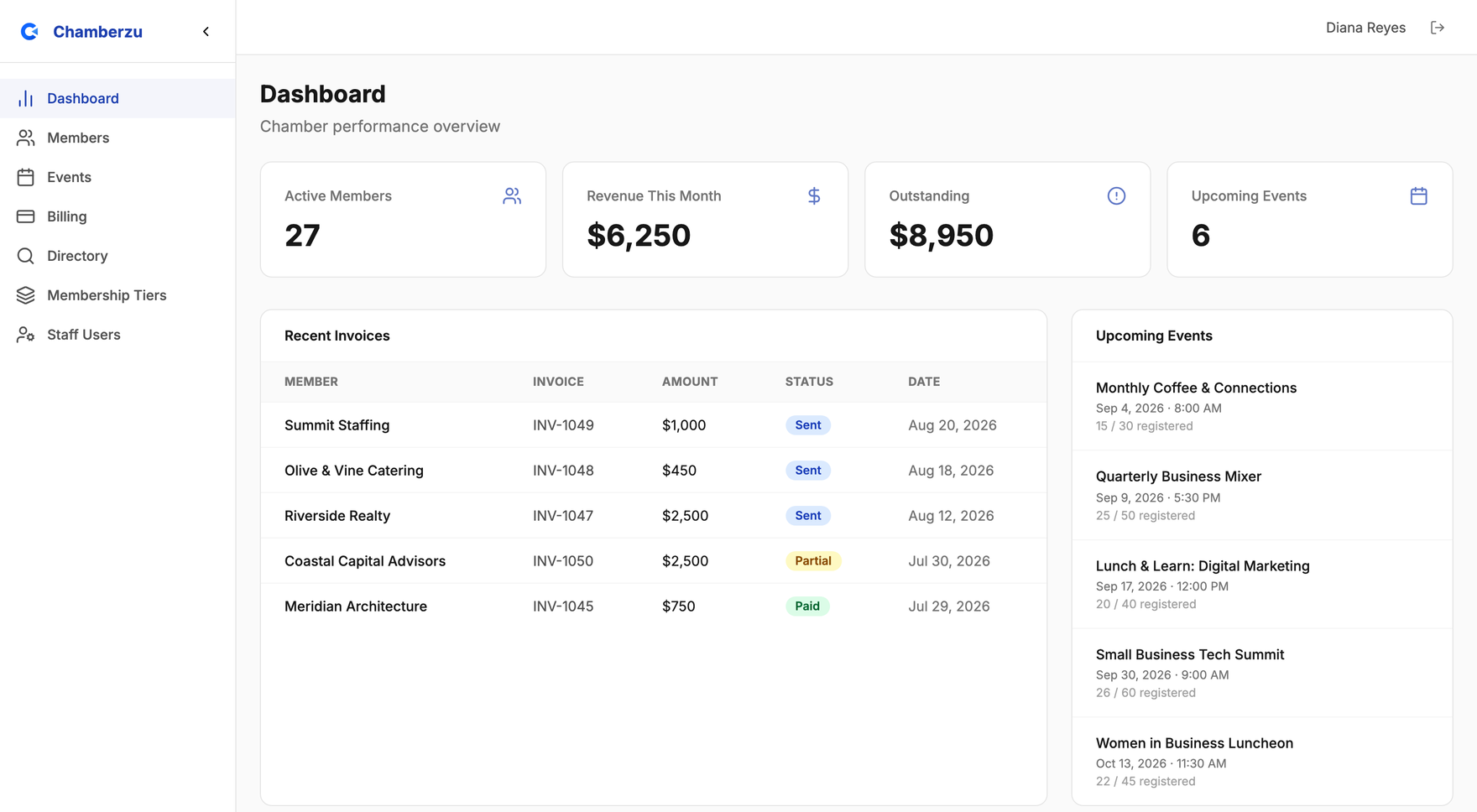
The Chamberzu executive dashboard showing active members, revenue this month, outstanding balance and upcoming events.
The dashboard an executive director opens before a board meeting.

Membership Director

Renewals depend on you remembering to chase them.

Retention is a follow-up problem long before it's a value problem. Most lapsed members didn't decide to leave — they got an invoice at a bad moment and nobody followed up. Automation doesn't replace your relationships; it makes sure the routine part never drops.

  • Renewal sequences that run on schedule and stop the second payment clears
  • A prospect pipeline that lives in the same system as your members
  • Engagement scores that tell you who to call this week
  • Tier benefits members can actually see, in the portal and the directory
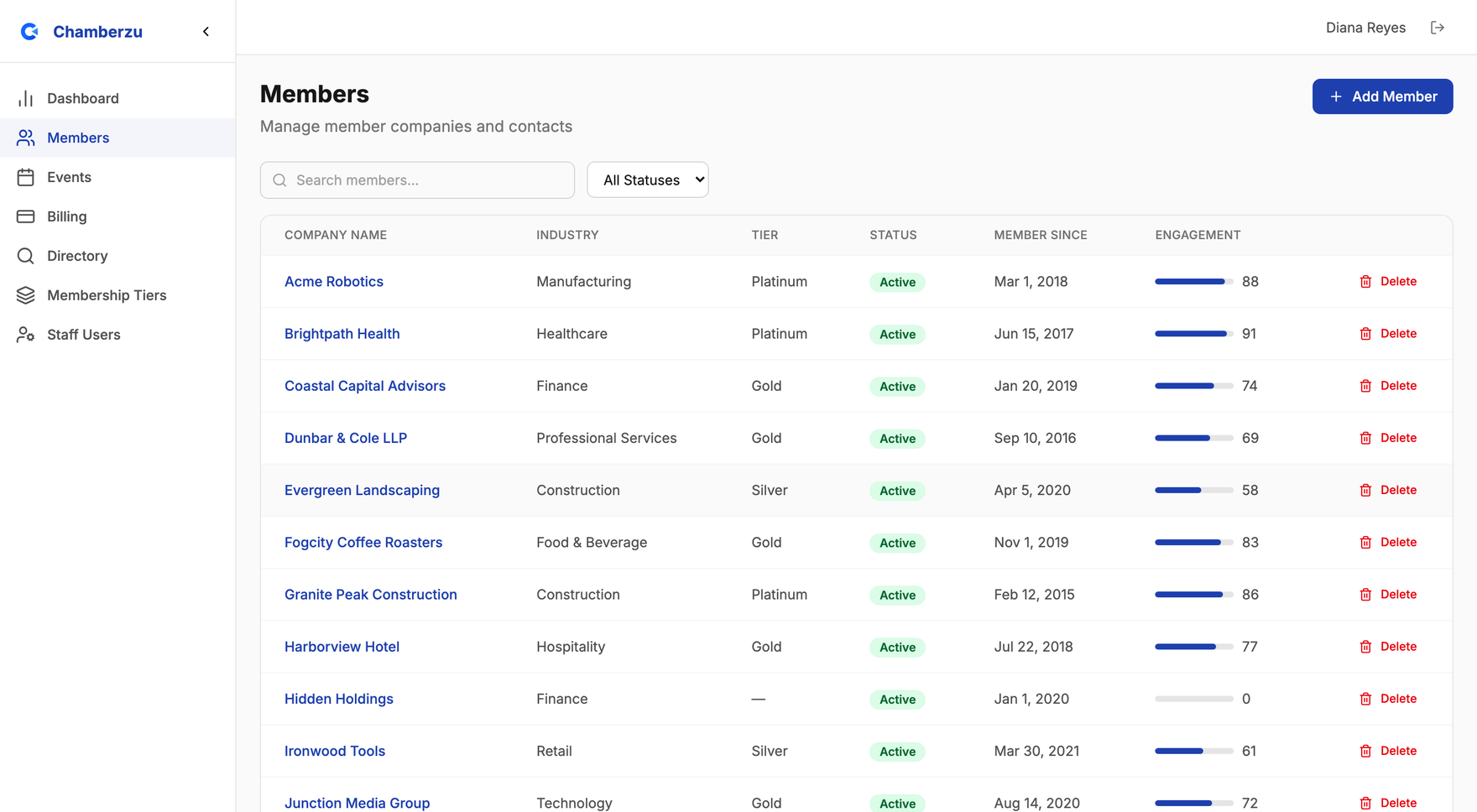
The Chamberzu members list showing member businesses with tier, industry, status and member-since date.
The member roster, filterable by tier and status.

Events Manager

Every event is a fresh spreadsheet and a frantic morning-of.

Registration lives in one tool, payment in another, the attendee list in a spreadsheet, and the name badges in a mail merge. The work isn't the event — it's the six systems that have to agree about who's coming.

  • Registration, payment, and the attendee list in one place by construction
  • Check-in from a phone at the door, including walk-up registrations
  • Sponsor packages and table sales handled alongside individual tickets
  • Revenue and attendance reporting the moment doors close
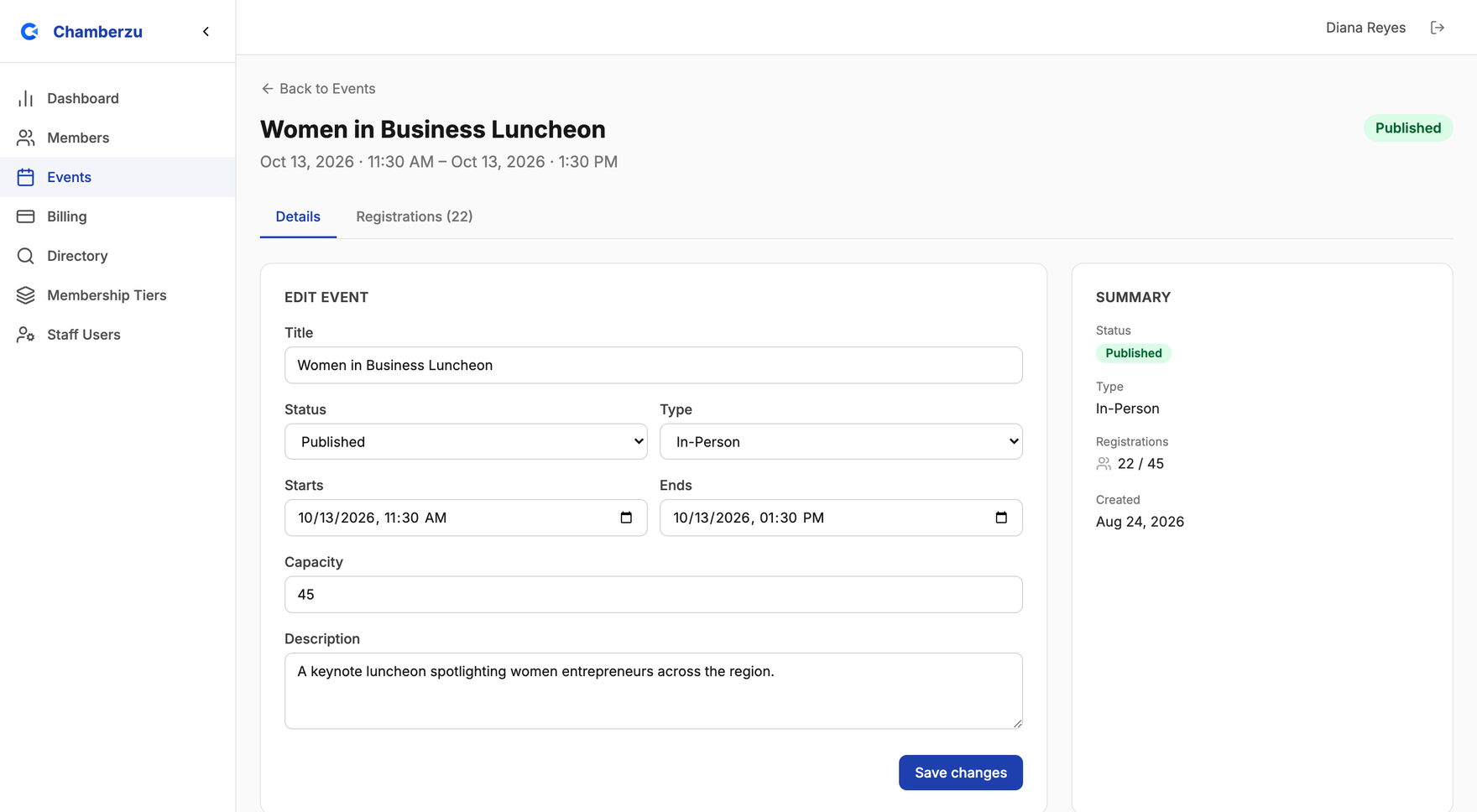
A Chamberzu event detail screen showing the event's status, times, capacity and a registrations tab with attendee count.
One event, with its registrations and capacity in the same place.

Finance & Operations

Reconciliation is a monthly ritual nobody enjoys.

Money arrives by card, by ACH, and by check, against invoices tracked somewhere else. Closing the month means matching three sources by hand and hoping nothing was recorded twice.

  • Payments reconcile against invoices automatically as they land
  • Checks and cash recorded against the same invoice, cleanly and auditably
  • Receivables aging you can see without building a report
  • Exports that match what your bookkeeper and auditor actually ask for
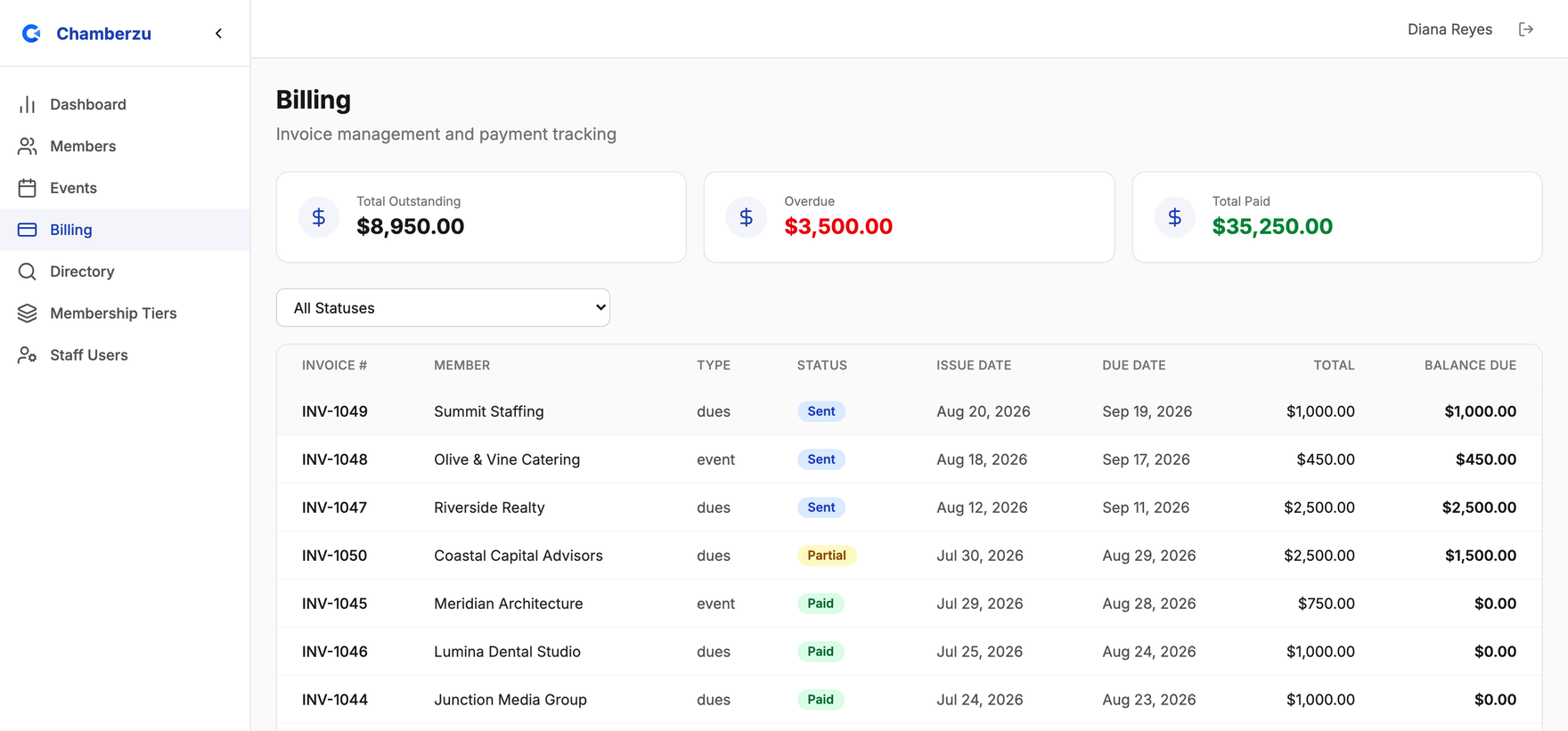
The Chamberzu billing screen showing outstanding, overdue and paid totals above a table of invoices with balances due.
Receivables and invoice status without building a report.
Honest scoping

When Chamberzu is the wrong choice.

We would rather say this on a website than three weeks into an implementation.

You're not a membership organization

The data model is built around member businesses, tiers, dues, and renewals. If your organization doesn't have members who pay to belong, a general-purpose CRM will fit you better.

You need deep fundraising or grant management

We handle sponsorships and event revenue well. Donor development, pledge tracking, and grant lifecycle management are a different discipline, and dedicated nonprofit fundraising tools do them better.

Your current system works and your staff likes it

Migration has a real cost in staff attention. If nothing is actually broken, the honest advice is to wait until something is — and then call us.

You need heavy customization on day one

Chamberzu is opinionated on purpose; that's why it takes weeks instead of months. If you need bespoke workflows before you'll consider it, an Enterprise conversation is the right starting point — not a self-serve signup.

Find your fit

Not sure which shape your chamber is?

Tell us your member count and what you're running today. We'll tell you what migration would look like — including if the answer is that you shouldn't bother yet.

No credit card. No obligation. A real conversation with the people who build the product.